Categories
Handling training Show dog training

Winning Paws First Junior Handling Training Day

Winning Paws First Junior Handling Training session
Yesterday (Saturday, 18 August) was the first handling session I organised under the Winning Paws name. Having been a Junior Handler myself, I wanted to offer the chance for the juniors to attend a training session. I was so pleased I was able to offer this session for free and I enjoyed myself and learnt something, I hope the attendee’s did too. Numbers were kept to a minimum but allowed the handlers to train with a different group of people.

The weather was hot and this meant keeping the dogs in the shade and lots of breaks back inside where it was slightly cooler to allow dogs and handlers to have drinks and a rest. Lots of mini Q&A sessions did lead to some interesting discussions with parents getting involved too.

Well done to those who attended. You all listened well and wish you all the best for your future handling classes.

What’s planned next?
I plan to run some more training sessions in the future and already have a waiting list. If you would be interested in being the first to know about any future training sessions, please get in contact via the website and as soon as any events are planned, I will let you know before posting on the website events page and Facebook.

Future sessions will include;

  • Junior Handling
  • Adult Handling
  • Breed Showing (getting the most from your dog for the show ring)
  • Different Breeds (A variety of different breeds available for handlers to practice with to acknowledge and respect different styles of handling required to suit different breeds)
  • Many more…

Don’t forget, I’m also available for group bookings for pre-existing ringcrafts or groups. Contact me for more details and costs.
Categories
Top Tips

Top Tip #20

Top Tip #20
Have “control” of the lead.

Learn to fold the lead in your hand to the desired length quickly, calmly and neatly.

In handling classes this is a must, in breed classes it looks professional and gives a cleaner performance.

Categories
Handling training

Shadowing

Shadowing
What is shadowing?
This is a technique used in handling classes. While the dog is standing, the judge will walk round the dog, or to the other side and expect the handler to move out the way not breaking the golden rule of never getting between the dog and the judge. This means the handler must become the judges “shadow”.

For shadowing, the handler must be able to walk around the dog without the dog moving. This can be practised anywhere and simply the dog needs to learn to stay.

It is easier with a stacked breed where you can hold the head, harder with a free stood dog.

To start with, I would stand the dog in the normal position. From here I will do slight movements, commanding the dog to stay and then praising. Building this up from just little movements, helps teach the dog what you want. I.e a free stood breed, while standing in front of the dog, my first movements would just be shifting my body weight.

Then you want to move onto taking a small step to the side. I.e if you are top and tailing your dog, I would take a small step to my left, giving the stay command, going back to the original position and praising the dog.

Keep building this up until your moving more and more. Praise the dog while they are standing still only. If they move, start again.

This technique builds the dogs confidence and teaches them the command.

Have fun training!

Categories
Getting started Handling training Show dog training

One must queue….correctly!

Standing in line
When in a class, everyone will be in a line/queue. Here are a few pointers to remember when you are standing in a line with all other handlers.

Firstly, work out where your dog prefers to be in the line and try to get to that position. Some dogs show better if they are first, others are better going last. In mixed breed classes, normally the table dogs go to the front. However, some judges will ask for the smaller dogs to be at the end of the line so always listen for instructions from either the judge or steward upon entry into the ring.

When standing your dog in the line always leave yourself room in front, approximately 2 meters. This is your escape route if the handler behind you crowds you. If you find yourself too crowded you have a number of options;

  • If they have room politely ask the handler behind to move back.
  • Move to the end of the line.
  • Ask the steward if they can move people back.

Always try to keep in line with the dogs in front of you.  If you stand back towards the edge of the ring you appear shy and reserved.

If you stand too far forward you will appear to be pushy and forcing yourself on the judge.

Also, avoid getting boxed into a corner where your dog could get obscured from the judge’s vision. In this instance, either start a new line or show your dog across the corner.

Wherever you are in the line, ensure your dog is stood when the judge is looking at him. Always keep one eye on the judge and one on the dog at all times, checking that you dog hasn’t moved and nor has the judge. You always want the judge to be seeing your dog at his very best.

Categories
Handling training Judging

The great debate – Junior Handling

The great debate – Junior Handling

There has been a lot of debate recently on forums, Facebook and the dog papers regarding Junior Handling and what is/isn’t correct, what judges should be looking for etc.

This has been something of discussion for many years ringside and amongst friends. Many years ago I remember Jackie Hurley (Jersey Junior Handling Association, JJHA) spent time offering Junior Handling judges days based on her thoughts about handling. Something I have not seen anyone else do. I think she also produced a judges list based on new judges and experienced judges.

My pet hate has always been handlers that can’t perform the basics, although can jump around their dog and want to do patterns maybe not seen in the breed rings!

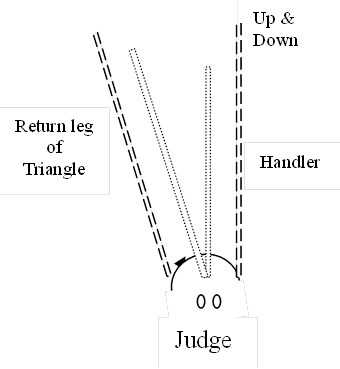
I like to see handlers who can show their dog to its best advantage. When asked for a triangle I expect to be shown the dogs movement. So when a handler is showing the rear or front movement, the dog should be in the judge’s line of sight without the judge having to move.  When showing the side movement, the dogs should be parallel to the judge to ensure the dog’s movement for the judge is seen at the best angle. Therefore straight lines are important; however corners are a different matter. The faster the dog and handler is moving, the harder it is to do a tight turn while keeping the speed. So therefore a good handler will do a turn which will keep the dog moving.

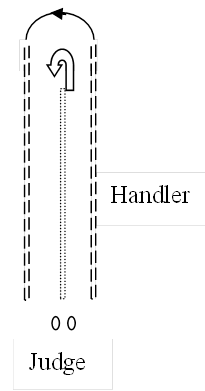
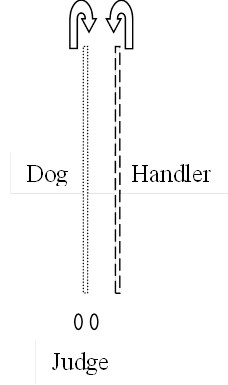
On an up and down, the straight lines are as important as in the triangle, so the judge can view and asses the front and rear movement. The turn at the top can then come into debate. Should it be a show turn (keeping the dog between the handler and judge) or an about turn which will break that rule? The about turn is used in the show ring as taking a dog round you will keep them moving, although sometimes when showing your dog, a show turn is better for a particular dog for a few reasons! So should both be allowed? Or do we keep the challenge for the handlers to not get between the dog and the judge?

So what about send-ons? This can be asked of either when doing circuits or when a handler is asked for a straight up and down and round to the end. In the breed ring we would break the rule of getting between the dog and the judge, but in the handling we would do a movement possibly never seen in the show ring. It’s a movement that has to be trained and isn’t naturally to a dog. I have seen many handlers who can’t seem to gasp this movement. But you do have to train the dog to do this and gain their confidence.

But overall, IN MY OPINION, Junior Handling should be about judging how good the handler is at showing their dog. It doesn’t matter if the dog they take in isn’t the greatest example of it’s breed, or even a crossbreed, but does the handler allow the judge to be able to assess their dog in all ways while blending into the background.

Maybe it’s time to get a group together of ex juniors and parents who can produce a “Breed Standard” blueprint for handlers and have a judges list, seminars etc which will help societies select judges that know about junior handling?


Categories
Top Tips

Top Tip #14

Top Tip #14
Remember at all times you are there to show your dog, not yourself, even in handling classes, a good handler is the one able to show their dog of to it’s best and will not distract the judges eye from the dog.

Categories
Top Tips

Top Tip #11

Top Tip #11
Don’t let your dog get into a habit of pacing out on walks. Try to get them into a correct trot as much as possible when lead walking.

Allowing them to pace all the time will build up the wrong muscles and could make them more likely to pace in the ring.

Categories
Handling training

The Three Turns

The Three Turns
There are three turns that can be used in handling classes to ensure that you never get between the dog and the judge. When showing your dog in the breed ring, these are less important.

The Inward Turn
The dog and handler both turn on the spot, inwards towards each other and the lead is passed to the other hand. This is typically used at the top of an ‘up & down’ when the judge has moved to the left to view the profile movement of the dog.  It is also used in the ‘T’ and ‘L’.


The Show Turn
The dog is slowed and turned on the spot as the handler moves round the outside of the dog. This is used at the top of an ‘up & down’ when the judge has moved to the right to view the profile movement of the dog and is the easiest turn to do if the judge stays in position.

The About Turn (In front of the judge)
This time the handler slows and walks backwards around the dog turning the dog on the spot. This is used at the when turning in front of the judge when joining two patterns together.  E.g. between a Triangle and an ‘up & down’.

Categories
Top Tips

Top Tip #9

Top Tip #9
Always keep training fun.

Training must be fun for both you and your dog to get the most out of it.Do this by playing games with your dog in training as a great reward.

If you are not in the right frame of mind for training in a happy, positive way then miss out the training and wait until you feel better.

Happy training!

Categories
Top Tips

Top Tip #7

Top Tip #7
Always congratulate those who win. Even if you don’t agree with the placings, a polite well done is all that is needed.

There is never an excuse for muttering negative comments for other exhibitors/judges to hear.